


Tabula Peutingeriana – Einzelanzeige
| Toponym TP (aufgelöst): | Mysucy |
| Name (modern): |
|
| Bild: | 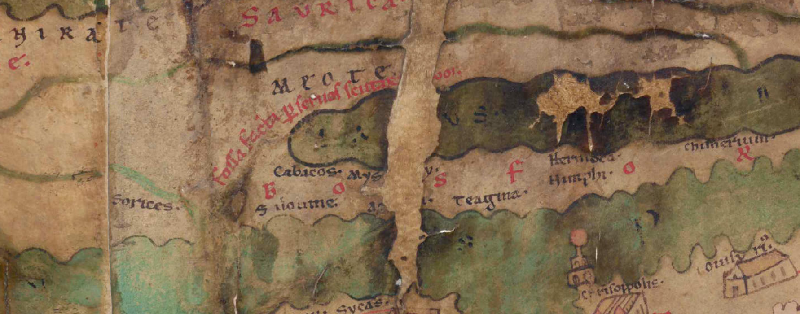 Zum Bildausschnitt auf der gesamten TP |
| Toponym vorher | |
| Toponym nachher | |
| Alternatives Bild | --- |
| Bild (Barrington 2000) |
 |
| Bild (Scheyb 1753) |
 |
| Bild (Welser 1598) |
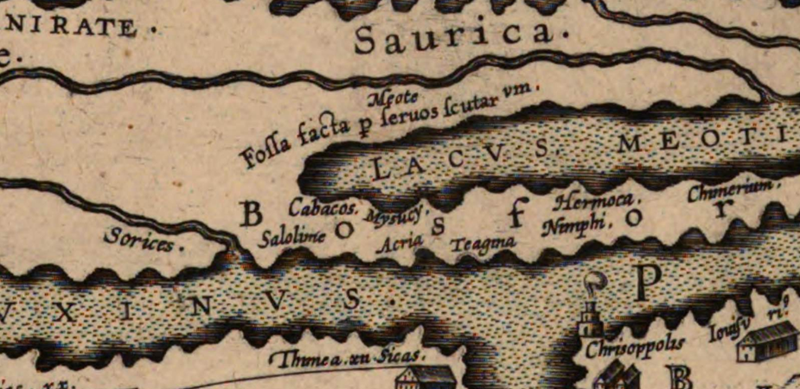 |
| Bild (MSI 2025) | --- |
| Pleiades: | https://pleiades.stoa.org/places/226691 |
| Großraum: | Skythien |
| Toponym Typus: | isolierter Name |
| Planquadrat: | 8A1 |
| Farbe des Toponyms: | schwarz |
| Vignette Typus : | --- |
| Itinerar (ed. Cuntz): |
|
| Alternativer Name (Lexika): |
|
| RE: | Myrmekion |
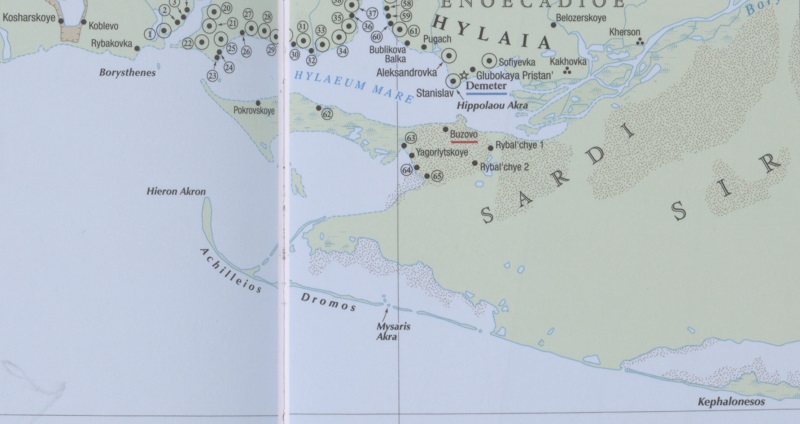
| Barrington Atlas: | Mysaris Akra (23 E2) |
| TIR / TIB /sonstiges: |
|
| Miller: |
|
| Levi: |
|
| Ravennat: |
|
| Ptolemaios (ed. Stückelberger / Grasshoff): |
|
| Plinius: |
|
| Strabo: |
|
| Autor (Hellenismus / Späte Republik): |
|
| Datierung des Toponyms auf der TP: | --- |
| Begründung zur Datierung: |
|
| Kommentar zum Toponym: |
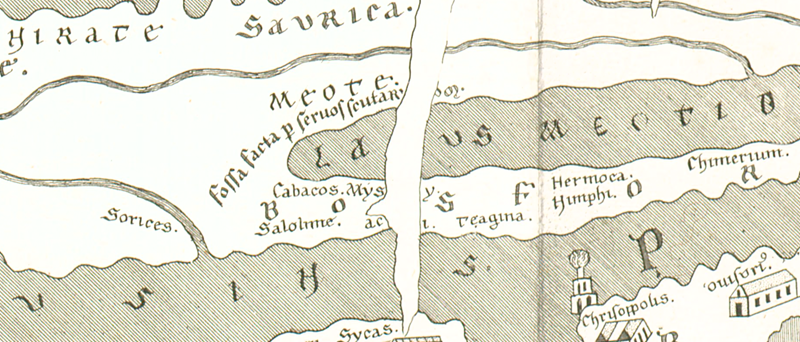
Die auf der TP erkennbaren Buchstabenreste lassen zunächst vielleicht an Mysaris Akra (Ptol. 3, 5, 8: Μισαρὶς [Μυσαρὶς] ἄκρα), die Ostspitze des Achilleos Dromos, denken: Welser liest Mysucy, Scheyb und Miller bieten entsprechend den auch heute auf der Karte erkennbaren Buchstaben die Lesung Mys-y. Wie bereits von Miller (Itineraria Romana, 619) vorgeschlagen, ist aber eher - schon auf grund der häufigeren Erwähnungen in der antiken Literatur - die bedeutende unabhängige Stadt Myrmekion auf der europäischen Seite des Kimmerischen Bosporus gemeint (Ps.-Skylax 68: Μυρμήκιον; Mela 2, 3: Myrmecion; Strab. 7, 4, 5 [310]; 11, 2, 8 [494]: Μυρμηκίον; Plin. nat. 4, 87: Myrmecium; Anon. Periplus Ponti Euxini 79/50: Μυρμηκίον), was sich allerdings schwerlich mit den noch lesbaren Buchstaben an dieser Stelle vereinbaren lässt. So äußert z.B. Talbert an dieser Gleichsetzung erhebliche Zweifel und zieht alternativ Mysaris Akra in Betracht (https://www.cambridge.org/us/talbert/talbertdatabase/TPPlace2808.html). Myrmekion war entweder eine griechische (ionische) Kolonie oder eine Gründung des nur 4 km entfernten Pantikapaion, zu dessen Städtebund der Ort dann auch gehörte. Myrmekion war ein wirtschaftlich bedeutender Ort; insbesondere durch Weinbau, Ackerbau, Viehzucht, Handwerk, Textilhandel und Fischfang gelangte der Küstenort zu Wohlstand. Entsprechend fanden sich in den dort unter der Leitung von Alexander Butyagin durchgeführten Ausgrabungen zahlreiche Münzen (die ältesten aus dem 6.Jh. v.Chr., die meisten aber aus dem frühen 4.Jh. v.Chr.). In Myrmekion gab es mehrere Tempel, z.B. für Demeter. Das von Talbert zur Buchstabenfolge Mys gezogene y steht so weit entfernt, dass man hier ein weiteres Toponym ansetzen könnte, etwa Kytaia (vgl. Ps.-Skylax 68: Κύταια; Plin. nat. 4, 86: Cytae; Ptol. 3, 6, 6: Κύταιον), das seit dem 5.Jh. v.Chr. zum Bosporanischen Reich gehörte und politisch abhängig war von Pantikapaion. |
| Literatur: |
Miller, Itineraria, Sp. 619; Albert Herrmann, in: RE XVI / 1, 1933, 1105 s.v. Myrmekion; Max Fluss, ebd., 1187 s.v. Mysaris promunturium (Μυσαρὶς ἄκρα); Iris von Bredow, in: DNP 8, 2000, 598 s.v. Myrmekion (Μυρμήκιον); Alexander V. Podossinov, Eastern Europe in Roman Cartographic Tradition, Moscow 2002, 345 [in Russian]; Alexandru Avram / John Hind / Gocha Tsetskhladze, The Black Sea Area, in: Mogens H. Hansen / Thomas H. Nielsen (Hrg.), An Inventory of Archaic and Classical Poleis: An Investigation Conducted by the Copenhagen Polis Centre for the Danish National Research Foundation, Oxford / New York 2004, 924-974, hier 947; Alexander Butyagin, The Hoard of Cyzicenes and Shrine of Demeter at Myrmekion, in: Ancient Civilizations from Scythia to Siberia 12 / 1-2, 2006, 77-132; Ders. / M.Y. Treister, A Bronze Olpe from the Myrmekion Hoard, ebd., 133-146; Alexander Butyagin, Archaic Myrmekion, in Sergey I. Solovyov (Hrg.), Greeks and Natives in the Cimmerian Bosporus, 7th-1st Centuries BC, Oxford 2007, 22-25; D.E. Chistov, Myrmekion in the Second Half of the 5th - Beginning of the 3rd Centuries BC: Investigation Results and Study Problems, ebd., 26-31; Mikhail G. Abramzon / Nina A. Frolova, Le trésor de Myrmekion de statères cyzicènes, in: Revue Numismatique 163, 2007, 15-44; Alexander Butyagin, Excavation of Ash Hill 2 in Myrmekion, in: Gocha R. Tsetskhladze / Alexandru Avram / James Hargrave (Hrg.), The Danubian Lands between the Black, Aegean and Adriatic Seas (7th Century BC-10th Century AD): Proceedings of the First International Congress on Black Sea Antiquities (Belgrade - 17-21 September 2013), Oxford 2015, 431-435; Ders., Essay on the Economy of Myrmekion in Pre-Roman Times, in: Gocha R. Tsetskhladze / Sümer Atasoy (Hrg.), Settlements and Necropoleis of the Black Sea Cities and its Hinterland in Antiquity. Select Papers from the Third International Conference „The Black Sea in Antiquity and Tekkeköy: An Ancient Settlement in the Southern Black Sea Coast“, 27-29 October 2017, Tekkeköy, Samsun, Oxford 2019, 108-112; Ders., Investigations of the Myrmekion Expedition in 2014-2018, in: Hyperboreus 25 / 1, 2019, 161-169; Ders., Myrmekion during and after Greek Colonisation, in: Gocha R. Tsetskhladze / Alexandru Avram / James Hargrave (Hrg.), The Greeks and Roman in the Black Sea and the Importance of the Pontic Region for the Graeco-Roman World (7th Century BC-5th Century AD): 20 Years On (1997-2017). Proceedings of the Sixth International Congress on Black Sea Antiquities (Constanța - 18-22 September 2017). Dedicated to Prof. Sir John Boardman to celebrate his Exceptional Achievements and his 90th Birthday, Oxford 2021, 78-83; Vladimir Kolosov, Ash Hill 2 of Myrmekion, ebd., 583-588; Alexander Butyagin, New Results of Excavations at Ancient Myrmekion, in: Hakan Öniz / Sergey Fazlullin (Hrg.), SOMA 2016: Proceedings of the 20th Symposium on Mediterranean Archaeology, Saint Petersburg, 12-14 May 2016, Oxford 2022, 1-6; Alexander Butyagin / Alexey Kasparow, The Economy of Archaic Myrmekion, in: Comparing Greek Colonies. Mobility and Settlement Consolidation from Southern Italy to the Black Sea (8th - 6th Century BC). Proceedings of the International Conference (Rome, 7.-9.11.2018), Berlin / Boston 2022, 150-162. |
| Letzte Bearbeitung: | 08.07.2026 14:39 |
Cite this page:
https://tp-online.ku.de/einzelanzeige.php?id=1957 [zuletzt aufgerufen am 05.10.2026]