deutsch englisch spanisch französisch italienisch
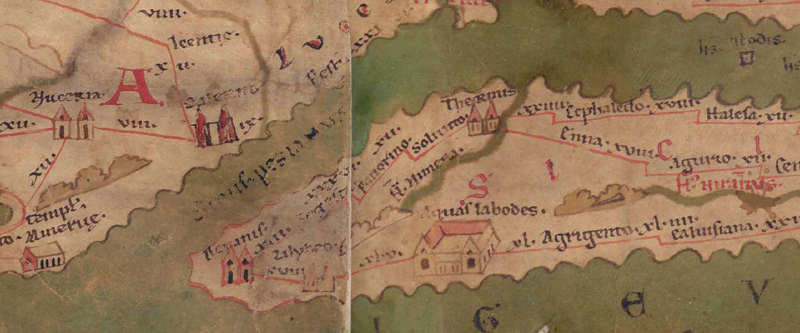
Part of Tabula Peutingeriana - Rome

Tabula Peutingeriana – Single display of hits

Toponym TP (renewed):

Solunto

Name (modern):

Solunto

Image:
To the image detail
Toponym before XII     Panormo     
Toponym following -     Thermis     
Alternative Image ---
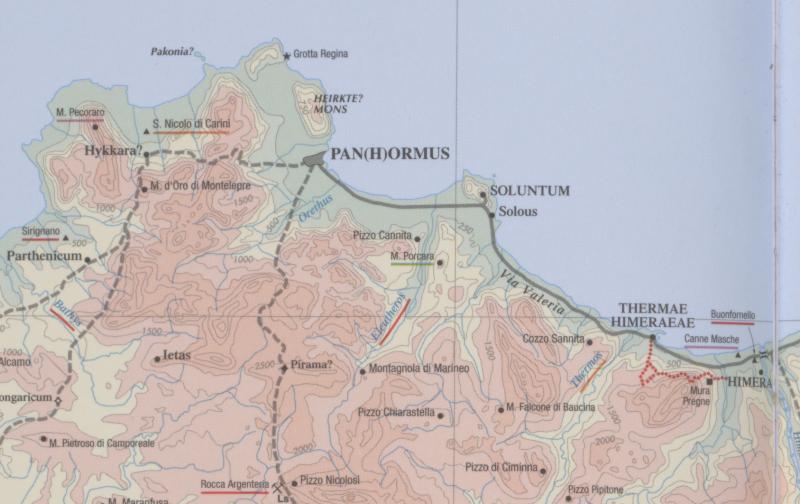
Image (Barrington 2000)
Image (Scheyb 1753) ---
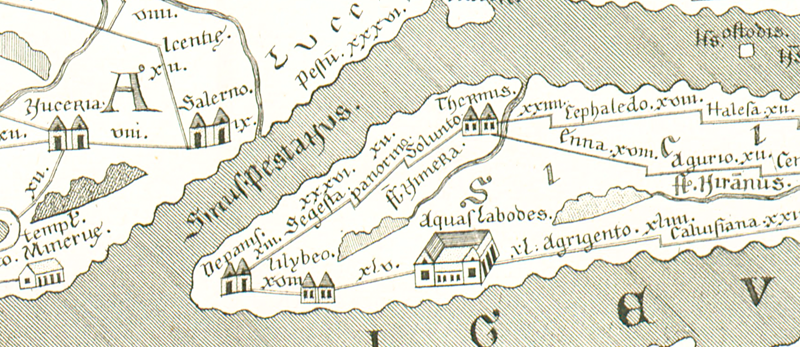
Image (Welser 1598) ---
Image (MSI 2025) ---
Pleiades: https://pleiades.stoa.org/places/462498
Area:

Mediterranean Islands

Toponym Type:

Toponym, no Symbol

Grid square:

6B1

Toponym Color:

black

Vignette Type :

---

Itinerary:

Solunto (91,6)

Alternative Name (Lexica):

Solus (DNP)

Name A (RE):

Solus - https://elexikon.ch/RE/IIIA,1_985.png

Name B (Barrington Atlas):

Soluntum (47 D2)

Name C (TIR/TIB/others):


Name D (Miller):

Solunto

Name E (Levi):


Name F (Ravennate):

Solantum (p. 100.31)

Name G (Ptolemy):


Plinius:


Strabo:


Dating from Toponym on TP:

---

Argument for Dating:


Commentary on the Toponym:

Kommentar (Talbert):
For the (indistinct) "n" in the name, see best the 1888 photograph.

Miller, Itineraria, Sp. 398:
Solunto, it. (It), Solantum (Ra), Solentos, Solentini (Cic, Diod), Σολόεις (Thuc), Solus (Steph, Diod, Pl, Pt); altes festes Städtchen mit gutem Hafen; j. Castello di Solanto. Iss: CIL X 7336. 8045 11. 8056. CIG 5576. 55776. 12, it. (It), stimmt.

Datierung (Barrington):
Soluntum – Hellenistic/Roman (Manni 1981, 225-26; Wilson 1990, 156-57)

DNP:
Solus
(Σολοῦς, Σολόεις, lat. Soluntum). Stadt an der Nordküste von Sicilia bei Cannita nahe dem h. Santa Flavia ca. 20 km westl. von Palermo (Grabfunde aus dem 6. Jh. v. Chr.). Wie Motye und Panormos war S. einer der Stützpunkte, auf die sich die Phönizier, bedrängt von griech. Kolonisten, um die Wende vom 8. zum 7. Jh. v. Chr. zurückzogen (Thuk. 6,2,6). Dionysios [1] I. nahm 397 v. Chr. die Stadt ein, mußte sie nach einem Rückschlag im J. darauf erneut erobern (Diod. 14,48,4 f.; 78,7). Die Bewohner gaben S. auf und ließen sich in der Nähe am Monte Catalfano nieder (orthogonale Stadtanlage, hell. Peristylhäuser). Karthago veranlaßte S. 307 v. Chr. zur Aufnahme von Söldnern des Agathokles [2], die sich vor Karthago ergeben hatten (Diod. 20,69,3 f.). Im 1. Punischen Krieg schloß sich S. Rom an (254 v. Chr.; Diod. 23,18,5). S. war civitas decumana der Prov. Sicilia (Cic. Verr. 2,3,103). Den letzten Zeugnissen von S. (Mz. unter Commodus) zufolge wurde die Stadt E. des 2. Jh. n. Chr. aufgegeben.
Olshausen, Eckart

References:

Desjardins, Table, p. 247, col. 1, no. 8.

Miller, Itineraria, Sp. 398.

V. Tusa, s. v. Soloeis, PE, 849 f.

Ders., s. v. Solunto, EAA 2. Suppl. 5, 1997, 327 f.

Ziegler, Konrat, Solus, in: RE III.A.1 (1927), Sp. 983-985.

   [Standard-Literatur-Liste im PDF-Format]

Last Update:

21.11.2025 19:09


Cite this page:
https://tp-online.ku.de/trefferanzeige_en.php?id=537 [last accessed on April 15, 2026]

Edition Information Privacy Statement