deutsch englisch spanisch französisch italienisch
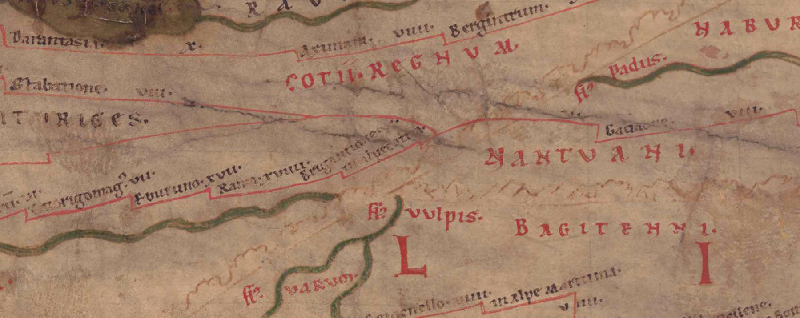
Part of Tabula Peutingeriana - Rome

Tabula Peutingeriana – Single display of hits

Toponym TP (renewed):

Brigantione

Name (modern):

Notre-Dame de Briançon

Image:
To the image detail
Toponym before XVIIII     Rama     
Toponym following XI     In alpecottia (In Alpe Cottia)     
Alternative Image ---
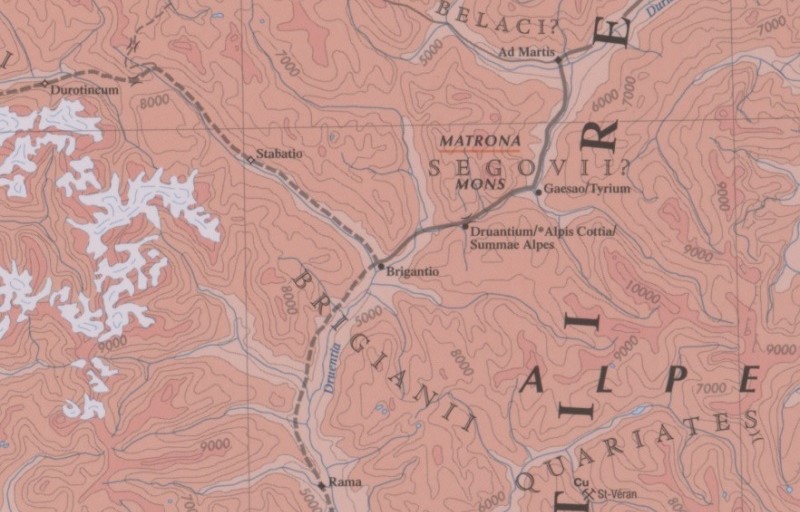
Image (Barrington 2000)
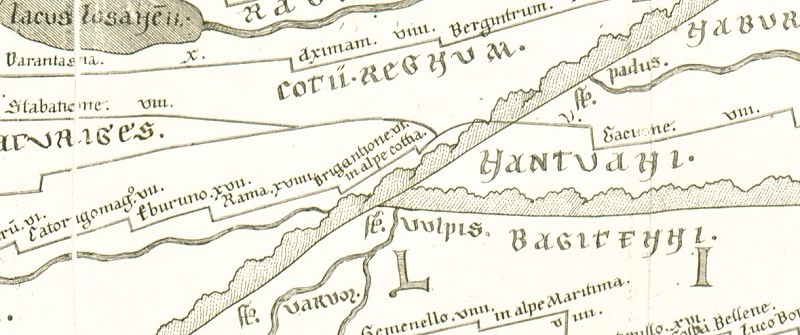
Image (Scheyb 1753)
Image (Welser 1598) ---
Image (MSI 2025) ---
Area:

Gaul/Germania

Toponym Type:

Toponym, no Symbol

Grid square:

2B3

Toponym Color:

black

Vignette Type :

---

Itinerary:

Brigantione (341,5; 357,3), mansio Byrigante (555,11) inde ascendis Matronam (556,1)

Alternative Name (Lexica):


Name A (RE):

Brigantio [1]

Name B (Barrington Atlas):

Brigantio (17 G2)

Name C (TIR/TIB/others):

Brigantio (TIR L 32, 40)

Name D (Miller):

Brigantione

Name E (Levi):


Name F (Ravennate):

Brincatione (p. 63.46)

Name G (Ptolemy):


Plinius:


Strabo:


Dating from Toponym on TP:

---

Argument for Dating:


Commentary on the Toponym:

Kommentar (Talbert):
-> stretch to IN alpecottia:
The next stretch (IN alpecottia) is to cross the mountain range (#14), and the copyist (or mapmaker ?) as usual wishes to avoid writing over it. He therefore places this name along the preceding stretch (Brigantione). But since this stretch is fairly short, no room remains for its own name and distance figure, which are written above instead. The result duly fulfils the aim of keeping the mountain range clear of lettering, but it creates other untidiness as well as potential confusion. At first glance, users of the map might well assume that the name IN alpecottia is placed above the stretch to which it relates, and that Brigantione above it names the following stretch. Only the fact that IN alpecottia lacks a distance figure close by (it is postponed to the far end of the following stretch, across the mountain range) tells against this assumption.

Miller, Itineraria, Sp. 102:
Brigantione, Brigantio Segusianorum, mansio Brigantum – inde ascendis Matronam (Hi), Brigantium (IG 1), Brigantio (IG 2.3), Brincatione (Ra), Brigantium (St), Virgantia (Am); j. Briançon. Iss: 93 bis 97. Meereshöhe 1204 m. Fortsetzung in Italien.

Miller, Itineraria, Sp. 228:
Brigantione, s.o.; j. Briançon. 6; it. (IG 3), bis Ad Martis 18 oder 22 oder 24 (It).

Datierung (Barrington):
Brigantio – Roman/Late Antique (Barruol 1969, 301, 316)

RE:
Brigantio [1]
Brigantio (Brigantium), Ort im südöstlichen Gallien (Strab. IV 179 διὰ Βριγαντίου κώμης κτλ.), im Gebiet der Cottischen [846] Alpen (Ptol. III 1, 36 Σεγουσιανῶν ἐν Γραίαις Ἄλπεσι Σεγούσιον ... Βριγάντιον, über den Irrtum des Ptol. vgl. Mommsen CIL V p. 810; Brigantione VI in Alpe Cottia Tab. Peut.; ἐν τῇ Βριγαντίᾳ Iulian. epist. ad S. P. q. Athen. p. 286 a. b), an der von Mailand über die cottischen Alpen nach Arles einerseits, nach Vienne andererseits führenden Strasse (Itin. Ant. 341. 357 Brigantione; Itin. Hier. 555 mansio Byrigantum). Amm. Marc. XV 10, 6 (Accus. Virgantiam) und Ennod. carm. I 1 (Brigantionis) bezeichnen es als Castellum. Brincatione beim Geogr. Rav. IV 27 p. 240. Heute Briançon an der Durance (Hautes-Alpes). Weitere Zeugnisse bei Holder Altcelt. Sprachschatz s. Brigantio(n) Sp. 537f. Die Form Brigantio scheint die ursprüngliche zu sein, so die Inschriften CIL XI 3284 (Brigantione). XII 94 (Brigantionis). 118 (Brigantione, dies vielleicht ein anderer Ort, s. unter Nr. 2); dagegen Brigantium CIL XI 3281, Brigantio 3282. 3283. O. Hirschfeld CIL XII p. 15 nimmt an, dass die Stadt, die auf der Inschrift XII 95 (vgl. 94) als municipium Brigantien. bezeichnet wird, in der ersten Kaiserzeit das ius Latii erhielt. Als Magistrate werden erwähnt (XII 95) quaestor und IIvir. Über die Strassen Brigantio-Arelate und Brigantio-Vienna Hirschfeld a. O. p. 645. 649.

RE
Brigantio [1]
https://elexikon.ch/RE/III,1_845.png

TIR
Brigantio (Briancon) Alpes Co. (Fr.) Hautes-Alpes II g
Oppidum, Strab. IV 179, Plin III 137; Ptolem. III 1,36; It. Anton. 341, 357; It. hieros. 555 (Byrigantum); Tab. Peut. geogr. Rav. IV 27 (Brincatio); CIL XI 3284; XII 93 ss. Municipio e Conventus civium Romanorum. Terme, fontana, tombe.
RE III 845 s. (Ihm); Bull. Arch. Com. 1914, 8 ss.; Bull. Soc. Et. Hautes-Alpes 1900, 195 ss.; 1938, 145 ss.; St. Lig 1944, 20 ss.

Inschriften/Distanzen
auf allen vier Vicarello Bechern aufgeführt
I Brigantium XVIII 18
II Brigantio XVIII 18
III Brigantio XVIII 18
IV Brigantione XVIII 18
Tabula Brigantione XVIIII 19

"TP-Online-ID: 3279 — Brigantione

Desjardins S. 58.

Lesung und Namensform bei Desjardins: Brigantione; normalisierte Form: BRIGANTIO SEGUSIANORUM.

Lage und Route bei Desjardins: Region/Lage: Alpes Cottiae; au IVe siècle dépendant de l’Italia. Typ: Oppid. et civitas. Route/Abschnitt: LXXI. de Vigenna, VIENNE, à In Alpe Cottia, MONT-GENÈVRE.

Quellenstellen bei Desjardins: It. Ant. 341,5 und 357,3: Brigantione; It. Burd. 555,11: mansio Byrigantum/Byrigante; 556,1: inde ascendis Matronam; CIL XI 3281–3284: BRIGANTIVM/BRIGANTIO/BRIGANTIONE; Ptol. Geogr. 3,1,36: Brigantion; CIL XII 57 = EDH HD065948:... SALONINO... ORDO BRIG, von Desjardins als Beleg für Briançon verwendet, tatsächlich aus Briançonnet; Amm. Marc. 15,10,6: castellum Brigantiam.

Moderne Identifikation bei Desjardins: Briançon.

Kommentar und Forschungsstand bei Desjardins: Desjardins versteht Brigantio als Knoten von vier Straßen und als oppidum und civitas der Alpes Cottiae. Itinerarium Antonini, Pilgeritinerar, Vicarello-Becher, Ptolemaios und Ammian sichern den alpinen Brigantio-Namen. Die von Desjardins zusätzlich benutzte ORDO-BRIG-Inschrift darf dagegen nach moderner Provenienz nicht auf Briançon bezogen werden.

Zusatz aus Desjardins’ Gallien-/Germanienanalyse (S. 72 und 77): In der systematischen Einzelprüfung der Narbonensis führt Desjardins diesen Namen unter den Ortsnamen, die er ausdrücklich als sicher vor dem Tod des Augustus bzw. spätestens augusteisch einstuft.

Bearbeitungshinweis: Wichtige Quellenkorrektur: CIL XII 57 stammt aus Briançonnet in den Alpes Maritimae und ist kein Beleg für Brigantio/Briançon. Ammian modern 15,10,6, nicht 15,10,7."

References:

Miller, Itineraria, Sp. 102. 228;

Ihm, Maximilian, Brigantio [1], in: RE III/1 (1897), Sp. 845-846.

   [Standard-Literatur-Liste im PDF-Format]

Last Update:

20.08.2026 12:37


Cite this page:
https://tp-online.ku.de/trefferanzeige_en.php?id=3279 [last accessed on August 25, 2026]

Edition Information Privacy Statement