


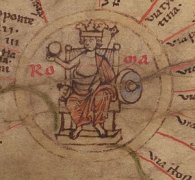
Tabula Peutingeriana – Display individuale
| Toponimo TP (sciolto): | Tanchire |
| Nome (moderno): |
|
| Foglio: |  |
| Toponimo davanti | |
| Toponimo dopo | |
| Foglio alternativo: | --- |
| Foglio (Barrington 2000) |
 |
| Foglio (Scheyb 1753) | --- |
| Foglio (Welser 1598) | --- |
| Foglio (MSI 2025) | --- |
| Area: | Asia a Est del Maiotis (Mare di Azov), a Nord del Tauro |
| Tipo di toponimo: | etnico |
| Quadrato: | 11A5 |
| Colore di toponimo: | rosso |
| Tipo di vignetta: | --- |
| Nome (Itinerario): |
|
| Nome alternativo (dizionari): | Tocharoi (DNP) |
| Nome (RE): | Tachoroi, Tocharoi |
| Nome (Barrington): | Tochari (6 B1); Tachoroi (6 B2) |
| Nome (TIR / TIB /altro): |
|
| Nome (Miller): | Tanchire |
| Nome (Levi): |
|
| Nome (Ravennat): | Tapurion (p. 20.42), Tocarion (p. 20.42) |
| Nome (Ptolemaios): | Τόχαροι μέγα ἔθνος (6,11,6); Τάχοροι (6,12,4); Τακοραῖοι (7,2,15) |
| Plinius: |
|
| Strabo: |
|
| Datazione del toponimo sulla TP: | primo periodo imperiale (compreso il periodo flavio) |
| Giustificazione della datazione: | Nachrichten über die Tocharer setzt in der späteren hellenistischen Zeit ein, gelangten aber erst durch Strabo, Plinius und Ptolemaios in die geographische Literatur des antiken Mittelmeerraumes. Daher dürfte der Eintrag in die Kaiserzeit zu datieren sein. |
| Commento al toponimo: |
Strab. 11, 8, 2 (511). 4 (511): Τόχαροι; Plin. nat. 6, 55: Thocari; Ptol. 6, 11, 7: Τόχα� |
| Letteratura: | Franz H. Weissbach, in: RE IV A / 2, 1932, 1989 s.v. Tachoroi; Miller, Itineraria, 626. 797; Albert Herrmann, in: RE VI A / 2, 1937, 1632-1641 s.v. Tocharoi; William W. Tarn, The Greeks in Bactria and India, Cambridge 1966 (2. Aufl. 2010), 515-519; Franz F. Schwarz, in: KlP 5, 1975, 878f. s.v. Tocharoi; Moti Chandra, Traders and Trade in Ancient India, New Delhi 1977, 95. 96; Fridrik Thordarson, in: Encyclopaedia Iranica 2 / 7, 1987, 764f. s.v. Asii, http://www.iranicaonline.org/articles/asii-or-asiani-an-ancient-nomadic-people-of-central-asia-who-about-130-b (zuletzt aufgerufen am 26.3.2020); Marek J. Olbrycht, Parthia et ulteriores gentes. Die politischen Beziehungen zwischen dem arsakidischen Iran und den Nomaden der eurasischen Steppen, München 1998 (= Quellen und Forschungen zur antiken Welt 30), 89-94; K Enok i/ G.A. Koshelenko / Z. Haidary, The Yüeh-Chih and their Migrations, in: János Harmatta / Baij N. Puri / G.F. Etemadi (Hrsg.), History of Civilizations of Central Asia, Vol. II: The Development of Sedentary and Nomadic Civilizations: 700 B.C. to A.D. 250, Paris 1996 (2. Aufl.), 171-189, hier 171-182; Stefan Falter, Taprobane im Wandel der Zeit. Das Śrî-Laṅkâ-Bild in griechischen und lateinischen Quellen zwischen Alexanderzug und Spätantike, Stuttgart 2000 (= Geographica historica 14), 92f.; Hans Jörg Nissen, in: DNP s.v. Tocharoi, http://dx.doi.org/10.1163/1574-9347_dnp_e1216430, 17.3.2018; Craig Benjamin, The Yuezhi, Origin, Migration and the Conquest of Northern Bactria, Turnhout 2007 (= Silk Road Studies 14); Étienne de la Vassière, The Triple System of Orography in Ptolemy’s Xinjiang, in: Werner Sundermann / Almut Hintze / François de Blois (Hrsg.), Exegisti Monumenta: Festschrift in Honour of Nicholas Sims-Williams, Wiesbaden 2009 (= Iranica 17), 527-535, hier 528-530; Schuol, Indien, 104f.; James P. Mallory, The Problem of Tocharian Origins: An Archaeological Perspective, in: Sino-Platonic Papers 259, 2015, http://sino-platonic.org/complete/spp259_tocharian_origins.pdf (zuletzt aufgerufen am 27.3.2020); Wei Lanha / Li Hui / Xu Wenkan, The separate Origins of the Tocharians and the Yuezhi: Results from recent Advances in Archaeology and Genetics, in: Melanie Malzahn / Michaël Peyrot / Hannes Fellner/Theresa-Susanna Illés (Hrg.), Tocharian Texts in Context: International Conference on Tocharian Manuscripts and Silk Road Culture, Held June 26-28, 2013 in Vienna, Bremen 2015, 277-299. [Standard-Literatur-Liste im PDF-Format] |
| Ultima modifica: | 14.01.2023 14:36 |
Cite this page:
https://tp-online.ku.de/trefferanzeige_it.php?id=2472 [zuletzt aufgerufen am 11.11.2026]