deutsch englisch spanisch französisch italienisch
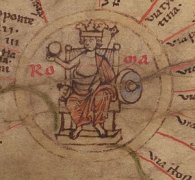
Ausschnitt aus der Tabula Peutingeriana - Rom

Tabula Peutingeriana – Pantalla individual

Topónimo (simplificado):

Pretorio

Nombre (moderno):

Pontarion?

Imagen:
Al detalle de la imagen
Topónimo antes XIIII     Ausrito     
Topónimo después XXIIII     Argantomago     XVIII     Acitodonum     
Imagen alternativa ---
Imagen (Barrington 2000)
Imagen (Scheyb 1753) ---
Imagen (Welser 1598) ---
Imagen (MSI 2025) ---
Pleiades: https://pleiades.stoa.org/places/138523
Área:

Galia/Germania

Tipo de topónimo:

Topónimo sin símbolo

Cuadrícula:

1B2 / 1B3

Color del topónimo:

negro

Tipo de viñeta:

---

Itinerario:


Nombres alternativos (diccionarios):


Nombre A (RE):


Nombre B (Barrington Atlas):

‘Pretorio’ (14 G3)

Nombre C (TIR / TIB /otros):


Nombre D (Miller):

Pretorio

Nombre E (Levi):


Nombre F (Ravenate):


Nombre G (Ptolemaios):


Plinius:


Strabo:


Datación del topónimo en la TP:

---

Fundamento para la datación:


Comentario al topónimo:

Kommentar (Talbert):
The stretch forks into two from the start, with the name (unusually) placed along the lower branch rather than the upper.
-> stretch to Argantomago
The brief upward kink in the earlier part of the stretch is curious. Did the copyist initially imagine that he had to make for Lemvno ?

Miller, Itineraria, Sp. 119:
Pretorio; j. Lage sehr unsicher. Die Entfernungen weisen auf Laurière, von wo nach allen 3 Richtungen stimmend.
18. In Moutier-d´Ahun wurde 1 Meilenstein gefunden: Pr[aetorio] 20, L[emovicibus] 34. I: 8911.

Miller, Itineraria, Sp. 120:
Pretorio, Strecke 25; j. Pontorion. In St. Leger-Magnazeix 1 Meilenstein gefunden: Aug. c. L(emovicorum) L. X (XV).
24 (Die Entfernung fehlt bei Bt, Bg, Ve); von Au̅g̅. rito 21 bis Arg. (It – zu wenig).

Datierung (Barrington):
‘Pretorio’ – Roman?/Late Antique (CAG 23, 37; Villes 482; Desbordes 1994)

"TP-Online-ID: 3158 — Pretorio

Desjardins S. 43.

Lesung und Namensform bei Desjardins: Pretorio; normalisierte Form: PRAETORIUM.

Lage und Route bei Desjardins: Region/Lage: Aquitania I. Typ: nicht näher bestimmt. Route/Abschnitt: LVIIII. de Lugduno, Lyon, à Ausrito, Limoges.

Quellenstellen bei Desjardins: keine Quellenstelle bei Desjardins angegeben.

Moderne Identifikation bei Desjardins: Unsicher: Arrènes; Pourrioux; Granmont; Mont-de-Jouer; Pontarion; Sauviat.

Kommentar und Forschungsstand bei Desjardins: Arrènes bei d’Anville, Notice de la Gaule, S. 533; Pourrioux bei Walckenaer III, S. 98; Granmont bei Katancsich I, S. 133; Mont-de-Jouer bei Lapie S. 233; Pontarion mit Resten einer römischen Brücke über den Thaurion bei Barailon, Recherches, S. 157; Sauviat bei Ukert II,2, S. 394 und Commission. Desjardins entscheidet hier nicht ausdrücklich.

Zusatz aus Desjardins’ Gallien-/Germanienanalyse (S. 77–78): In der systematischen Einzelprüfung der Aquitania führt Desjardins diesen Namen unter den Ortsnamen, die er ausdrücklich als sicher vor dem Tod des Augustus bzw. spätestens augusteisch einstuft.

Bearbeitungshinweis: Keine antike Parallelquelle."

Bibliografía:

Desjardins, Table, p. 43, col. 2, no. 11.

Miller, Itineraria, Sp. 119. 120.

   [Standard-Literatur-Liste im PDF-Format]

Última elaboración:

20.08.2026 11:25


Cite this page:
https://tp-online.ku.de/trefferanzeige_es.php?id=3158 [zuletzt aufgerufen am 13.11.2026]

Derechos Política de privacidad