deutsch englisch spanisch französisch italienisch
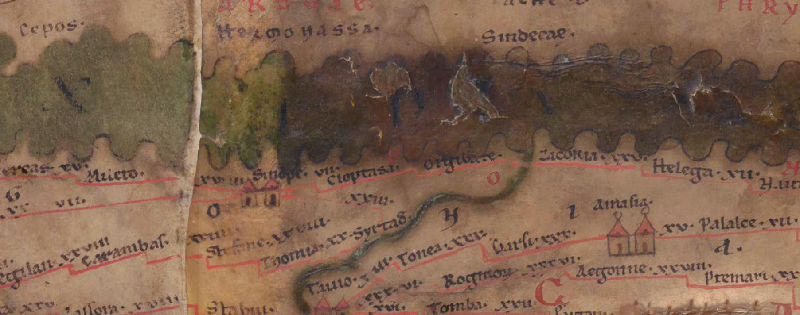
Ausschnitt aus der Tabula Peutingeriana - Rom

Tabula Peutingeriana – Pantalla individual

Topónimo (simplificado):

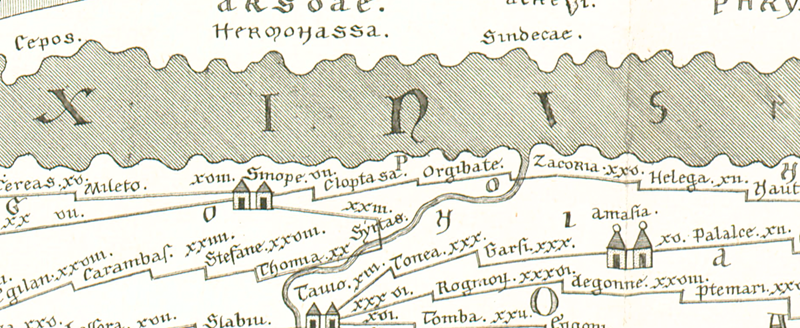
Cloptasa

Nombre (moderno):

? Demirci köy? oder Eren Boğazı?)

Imagen:
Al detalle de la imagen
Topónimo antes VII     Sinope     
Topónimo después -     Orgibate     
Imagen alternativa ---
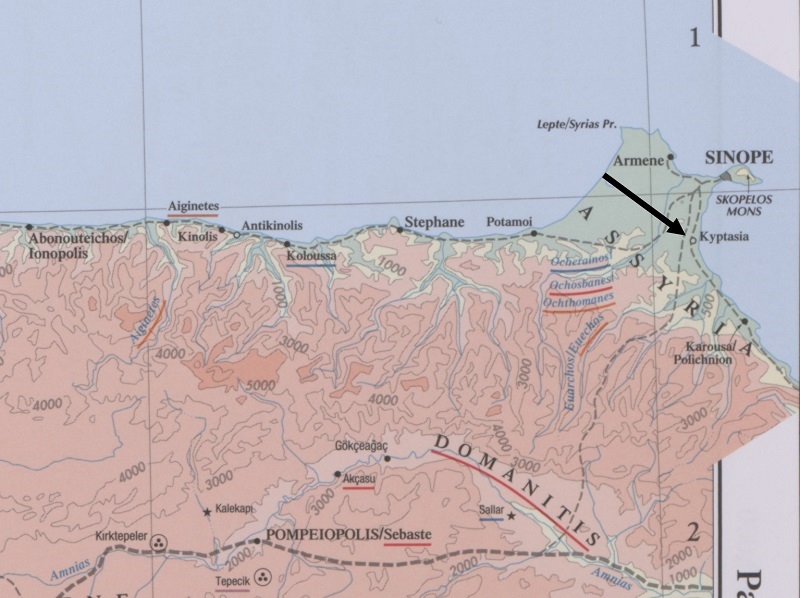
Imagen (Barrington 2000)
Imagen (Scheyb 1753)
Imagen (Welser 1598) ---
Imagen (MSI 2025) ---
Pleiades: https://pleiades.stoa.org/places/844996
Área:

Asia Menor

Tipo de topónimo:

Topónimo sin símbolo

Cuadrícula:

9A1

Color del topónimo:

negro

Tipo de viñeta:

---

Itinerario:


Nombres alternativos (diccionarios):


Nombre A (RE):

Kyptasia

Nombre B (Barrington Atlas):

Kyptasia (86 F2)

Nombre C (TIR / TIB /otros):


Nombre D (Miller):

Cloptasa

Nombre E (Levi):


Nombre F (Ravenate):

Cyptasa (p. 29,31); Cloptasa (p. 92,6)

Nombre G (Ptolemaios):

Κυπτασία (5,4,3, var. lect. Κοπτασία)

Plinius:


Strabo:


Datación del topónimo en la TP:

Período Imperial (siglo segundo)

Fundamento para la datación:

Erstmals belegt bei Ptol.

Comentario al topónimo:

Gleiche Namensform:
Rav 5,10 p. 92,6 Sinopi – Cloptasa (v. l. Cloptosa) – Carusa

Alternative Namensformen:
- ähnlichste Namensform: Clopatassa Guido 101 Sinopi – Clopatassa – Carusa
- vgl. Κοπτασία als Lesart von Γ bei Ptol. (s. Müllers Apparat)
- Cyptasa Rav 2,17 p. 29,31 Sinopi - Cyptasa – Carusa
- Κυπτασία Ptol. 5,4,3 (zu Galatia), ebenfalls nach Sinope aufgeführt.

Die ursprüngliche korrekte Form (falls es eine solche einheitlich gegeben hat) müsste wohl “Cyptasia” (Κυπτασία bei Ptol.) gelautet haben, was offenbar bereits auf den gemeinsamen spätantiken Vorlagen von TP, Rav und Guido bzw. von TP und Rav verschrieben war zu Cloptasa bzw. Cyptasa.
Einen thrak. Namensursprungs vermutete Müller comm. ad Ptol. 5,4,2, aber Detschew 1957 führt den Ortsnamen nicht.
Schnetz 43f vermutet, dass in der gemeinsamen Vorlage eine Maiuskel der Form oYo_ gestanden haben könnte, das teilweise als L mit hochgestelltem o verlesen wurde (wobei nicht auszuschließen sei, dass Rav zwei verschiedene Quellen benutzt hat)

Eine Identität mit Guzubanthon/Γουρζούβανθον im Anon. peripl. Pont. Eux. 24 vermutete ItMiller 644, der den Ort bei Eren Boghasi lokalisierte (so auch noch BAtlas 86 F2) doch heute identifiziert man Guzubanthon meist mit der folgenden Station 9A1 Orgibate (z. B. BAtlas 87 A3).

Die Straßenstation lag jedenfalls an der Küste von Paphlagonien, eigentlich südsüdwestlich von Sinope (Ptol. 5,4,3; s. Ruge, RE 126).

Die Koordinaten, die Ptol. 5,4,3 angibt, bieten keinen sicheren Hinweis da sie möglicherweise auf einer Verwechslung mit Karusa (heute: Gerze) beruhen (s. Dan 2009, 116). Die Lokalisierung erfolgt meist bei Eren Boğazı aufgrund der Distanzangabe in der TP von 7 Meilen von Sinope aus (so bereits Müller, Comm. ad Ptol. 5,4,2 bzw. 5,4,3 nach moderner Zählung, gefolgt von Ruge/Bittel, RE 2545) bzw. nach Demirci/Demirciköy, 16 km. ssw. von Sinop, das vor allem in der Römerzeit aktiv war, im Blick auf die dortigen Grabungsfunde (s. Dan 2009, 116; Bibl. zu den Grabungungsberichten von 1996-2001 ibd.), beschrieben bei D. Kassab-Tezgör AnatAnt 4 (1996), 325-334 und 335-354; 6 (1998), 423-442 und 443-449; 9 (2001), 215-225, sowie die Grabungsberichte in der Zeitschrift Kazı Sonuçları Toplantısı (1994-1999 und 2001).

Meilenangabe nach Orgibate: fehlt


Miller, Itineraria, Sp. 644:
Cloptasa, it. Und Cyptasa (RA), Cyptasia (PT), Clopatassa (GU); vielleicht = Gurzubanthon (Peripl); j.Eren Boghasi. RA schiebt ein: Carusa, it. (Gu, Arr, 150 st von Sinope und 150 st bis Zagora), sonst Carussa; j. Gerseh. –, fehlt, es sind ca. 14.

Bibliografía:

Dan, Anca: Sinope,«capitale» pontique, dans la géographie antique, in: Bru, Hadrien/ Kirbihler, François/Lebreton, Stéphane (Hgg.): L´Asie mineure dans l´Antiquité: échanges, populations et territoires: Regards actuels sur une péninsule, Rennes 2009, 67-131.
https://books.openedition.org/pur/98385.

Detschew, Dimiter: Die thrakischen Sprachreste, Wien 1957.

Kassab Tezgör, Dominique: From hypothesis to survey, from survey to excavations and back to hypothesis. The conclusions of 10 years of work in the amphorae workshop at Sinope-Demirci, Archaeologia Polona, 41 (2003), 209-211.

Kassab Tezgör, Dominique/Özsalar, Ahmet: The Reconstruction of a Roman Kiln in the
Archaeological Museum of Sinop, Ancient Civilizations from Scythia to Siberia 16 (2010) 199-216, 543-546.

Kassab Tezgör, Dominique: Types amphoriques romains tardifs produits simultanément à Demirci près de Sinope et dans d´autres centres, in: Tzochev, Chavdar (Hg.): PATABS II, production and trade of amphorae in the Black Sea: acts of the international round table held in Kiten, Nessebar and Sredetz, September 26 - 30, 2007, Sofia 2011, 259-264.

Miller, Itineraria, Sp. 644.

Ruge, W.: Kyptasia, RE 12,1 (1924), 126.

Ruge, W./Bittel K: Paphlagonia, RE Suppl. 18,4 (1949), 2486-2550, hier: 2545.

Schnetz, Joseph: Untersuchungen über die Quellen der Kosmographie des anonymen Geographen von Ravenna (= Sitzungsberichte der Bayerischen Akademie der Wissenschaften Jahrgang 1942, Heft 6), München 1942, 43f.
https://www.zobodat.at/pdf/Sitz-Ber-Akad-Muenchen-phil-hist-Kl_1942_0001-0087.pdf.

   [Standard-Literatur-Liste im PDF-Format]

Última elaboración:

12.08.2025 14:29


Cite this page:
https://tp-online.ku.de/trefferanzeige_es.php?id=1337 [zuletzt aufgerufen am 19.04.2026]

Derechos Política de privacidad