



Tabula Peutingeriana – Pantalla individual
| Topónimo (simplificado): | Mastrum |
| Nombre (moderno): | Amasra |
| Imagen: | 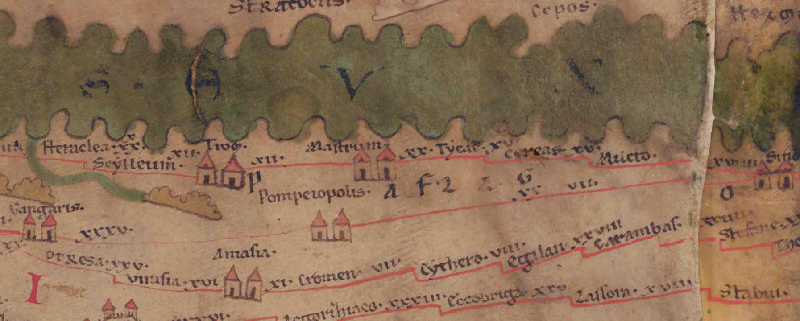 Al detalle de la imagen |
| Topónimo antes | XII Tium |
| Topónimo después | XX Tycae |
| Imagen alternativa | --- |
| Imagen (Barrington 2000) |
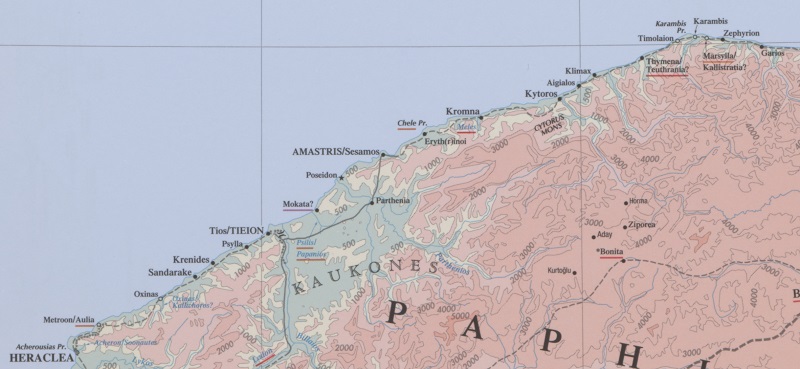 |
| Imagen (Scheyb 1753) |
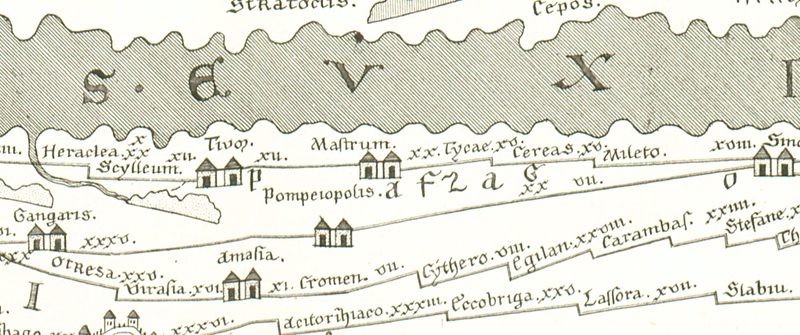 |
| Imagen (Welser 1598) | --- |
| Imagen (MSI 2025) | --- |
| Pleiades: | https://pleiades.stoa.org/places/844856 |
| Área: | Asia Menor |
| Tipo de topónimo: | Topónimo con símbolo |
| Cuadrícula: | 8A5 |
| Color del topónimo: | negro |
| Tipo de viñeta: | A Torre doble |
| Itinerario: |
|
| Nombres alternativos (diccionarios): |
|
| Nombre A (RE): | Amastris 1 |
| Nombre B (Barrington Atlas): | Amastris/Sesamos (86 C2) |
| Nombre C (TIR / TIB /otros): | Amastris (TIB 9, 161-170) |
| Nombre D (Miller): | Amastrum |
| Nombre E (Levi): | Mastrum (A,II,1) |
| Nombre F (Ravenate): | Amastra (p. 29,28; p. 91,45) |
| Nombre G (Ptolemaios): | Ἄμαστρις (5,1,7) |
| Plinius: |
|
| Strabo: |
|
| Datación del topónimo en la TP: | Antigüedad Tardía (desde Diocleciano y siglo IV) |
| Fundamento para la datación: | Die Vignette zeigt die Stadt auf dem Höhepunkt ihrer baulichen Entwicklung seit trajan. Zeit (Plin. epist. 10,98; Inschr. und Reste der röm. Architektur), die Zuordnung zu Paflagonia weist auf die Zeit seit den diocletian. Provinzreformen. Die Namensform geht jedoch wohl auf eine noch spätere Zeit zurück, in der Amastris immer noch bedeutend war (s. Artikel). |
| Comentario al topónimo: |
Die Namensform Mastrum ist verstümmelt aus *Amastrum (nicht belegt), das seinerseits wahrscheinlich eine Verschreibung aus der wohl späten Nebenform Amastram darstellt, vgl. |
| Bibliografía: |
Avram, Alexandru/Hind, John/Tsetskhladze, Gocha: Sesamos (Sesamenos)/Amastris (Amastrianos), in: Hansen, Mogens Herman/Nielsen, Thomas Heine: An inventory of archaic and classical poleis, Oxford 2004, 960. |
| Última elaboración: | 30.06.2025 19:23 |
Cite this page:
https://tp-online.ku.de/trefferanzeige_es.php?id=1197 [zuletzt aufgerufen am 19.04.2026]