deutsch englisch spanisch französisch italienisch
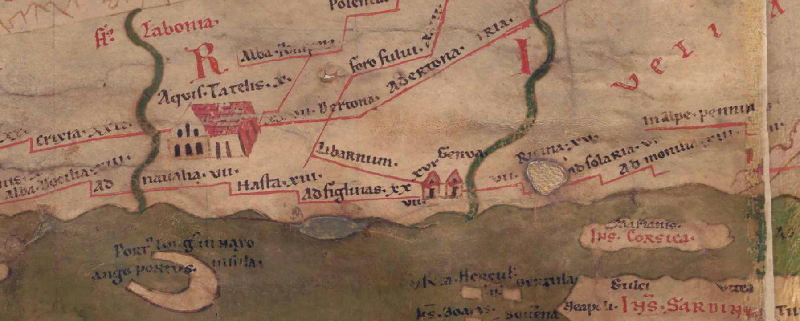
Part of Tabula Peutingeriana - Rome

Tabula Peutingeriana – Single display of hits

Toponym TP (renewed):

Libarnum

Name (modern):

Serravalle Scrivia

Image:
To the image detail
Toponym before -     Dertona     
Toponym following XVI (?)     Genva (Genua)     
Alternative Image ---
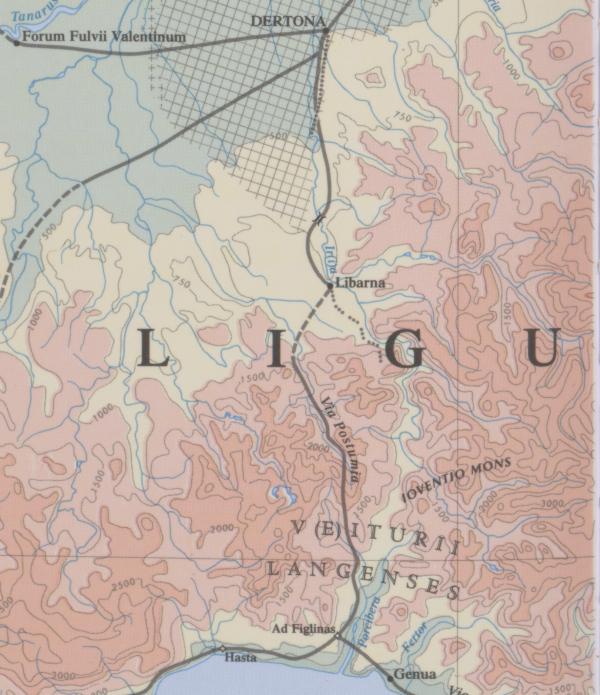
Image (Barrington 2000)
Image (Scheyb 1753) ---
Image (Welser 1598) ---
Image (MSI 2025) ---
Pleiades: https://pleiades.stoa.org/places/383694
Wikipedia https://it.wikipedia.org/wiki/Libarna
Area:

Italy

Toponym Type:

Toponym, no Symbol

Grid square:

2B5

Toponym Color:

black

Vignette Type :

---

Itinerary:

Libanum (294,5)

Alternative Name (Lexica):

Libarna (DNP)

Name A (RE):

Libarna - https://elexikon.ch/RE/XIII,1_13.png

Name B (Barrington Atlas):

Libarna (39 D4)

Name C (TIR/TIB/others):

Libarna (TIR L 32, 84)

Name D (Miller):

Libarnum

Name E (Levi):


Name F (Ravennate):

Levarmis (p. 71.01), Levarnis (p. 71.05)

Name G (Ptolemy):

Λιβάρνα (Λίβαρνον) (3,1,45)

Plinius:

Libarna (3,49)

Strabo:


Dating from Toponym on TP:

Early Empire (including Flavian period)

Argument for Dating:

Erste überlieferte literarische Erwähnung bei Plinius dem Älteren.

Commentary on the Toponym:

Kommentar (Köhner)
a) Lesung und Rekonstruktion des Namens
Libarnum

b) Moderne(r) Name(n) und Verortung(en)
Serravalle Scrivia

c) Namensformen belegt bei antiken Autoren
Libarna (Plin. nat. 3,49), Λιβάρνα (Λίβαρνον) (Ptol. geogr. 3,1,45), Libanum (It. Ant. 294,5), Levarmis (Geogr. Rav. p. 71.01), Levarnis (Geogr. Rav. p. 71.05)

d) Datierung der Namensform auf der TP
Der Ort ist frühestens bei Plinius dem Älteren belegt, sein Eintrag auf der Karte damit spätestens frühkaiserzeitlich zu datieren.

e) Bedeutung des Toponyms in der Antike
Miller, Itineraria, Sp. 253:
Libarnum, Libarium (It), Libarna (Pl, Pt), Levarnae, Levarnis und Lavarie (Ra), Levarnis (Gu), Λιβερῶν[α] (Sozom.), nicht unbedeutender Ort; j. Serravalle. Iss: CIL V 7423-7442. 36 (Irrig 26 (Bt, Bg, Ve); die XX neben Figlinas könnte man auch zu der darunter stehenden Zahl 7 zählen. Sie wäre aber dort zu viel, während sie hier fehlen.), it. (It). Die Entfernung 36 über den Apennin entspricht der Wirklichkeit, wenn auch die gerade Linie bedeutend kürzer ist.

DNP: Libarna
Ligur. Stadt der regio IX an der Via Postumia (nobile oppidum, Plin. nat. 3,49), h. Serravalle Scrivia. Municipium, dann wohl colonia (CIL V 7428), tribus Maecia. Evtl. von Constantinus [3] 410 n.Chr. erneuert ([1] zu Soz. 9,12,4). Überreste: Theater, Amphitheater, insulae, Thermen, Forum, Aquädukt, Gräber. [Salomone Gaggero, Eleonora (Genua)]

RE: Libarna, heute Serravalle in Ligurien, zur Tribus Maecia gehörig, genannt außer in den Itinerarian Itin. Ant. 294. Tab. Peut. bei Plin. n.h. III 49. Ptolem. III 1,45. Die Lage des Ortes wird durch Inschriftsfunde CIL V 6425 p. 838 bestimmt, wohl identisch mit dem Ort, den Sozom. hist. eccl. IX 12 Λιβερῶν απόλιν τῆς Λιγουρίας nennt. An der Via Postumia gelegen ist L. 26 mp. von Genua entfernt. Die Alimentartafel von Veleia nennt im Gebiet von L. 3 pagi, den Eboreus, Martius und Moninas, der auch zu Veleia gehört, also der Grenzpagus ist. Vgl. Arch. Anz. 1921, 36. [Philipp].

TIR: Libarna (Serravalle Scrivia) R. IX (It.) Alessandria Vi g
Plin. III 5. Ptolem. III 1,45; It. Anton. (Libarium) 288, 294; Tab. Peut. (Libarnum); Geogr. Rav. (Leuarnis) IV 33; CIL V 7424 ss. Municipio (tr. Maecia) in età augustea, poi colonia. Porta urbica, teatro, anfiteatro, terme, strade, insule, sepolcreto.
Poggi, Mem. XII Congr. Stor. Sub. 1909; Monaco FI IX, I; Lamboglia, Lig. rom. 243 ss.; Diz Epigr. IV 24, 795 ss.; NS 1941, 29; 1950, 221 ss.; 1952, 211 ss.; SL 1947, 35 ss.; BSPA 1953, 26 ss.

f) wenn vorhanden: Kommentar zur Vignette
-

g) Kommentar zur Einzeichnung auf der TP (Gestaltungsfehler/Folgefehler?)
-
h) Hinweise zum Streckennetz und den Distanzangaben
Kommentar (Talbert): -> stretch to Genua:
ItAnt 294,5 lists the Genva-Libarnvm distance as XXXVI. Originally, therefore, in all likelihood it was this figure which straddled that stretch on the map (to fit it along the stretch after the name Libarnvm, by contrast, would be a tight fit). Eventually, however, a copyist took the first XX to be the beginning of the distance figure for Adfiglinas. So its distance figure became XXVII instead of VII, and that of Libarnvm XVI instead of XXXVI; even so, the XVI continued to be placed on a slant. ItMiller (see lithograph, col. 29) overlooks the continuation of route linework down left from Libarnvm towards the start of the Adfiglinas stretch. Perhaps this was never more than a slip or embellishment. If a route stretch continuing to Adfiglinas was intended, however, then there is indeed no distance figure, and the break of linework to accommodate the distance figure for Hasta is unusual (but compare the clear instance under Amavante, 9C1). On the other hand, to judge by BAtlas 39 D5, it would in fact be more accurate to represent the route from Libarnvm to Genva as passing through Adfiglinas rather than proceeding direct.

References:

[1] Desjardins, Table, p. 106, col. 2, no. 1 (unter no. 43).

[2] Finocchi 1995

[3] Miller, Itineraria, Sp. 253.

[4] Philipp, Hans, Libarna, in: RE XIII.1 (1926), Sp. 13.

[5] Salomone Gaggero, Eleonora, Libarna, in: DNP 7 (1999), Sp. 133.

1 G.Chr. Hansen, in: J. Bidez (Hrsg.), Sozomenus, Kirchengesch. (GCS N.F. 4), 21995, 545.

G. Forni (Hrsg.), Fontes Ligurum et Liguriae antiquae, 1976, s.v. L.

S. Finocchi (Hrsg.), L., 1996.

Libarna (TIR L 32, 84).

   [Standard-Literatur-Liste im PDF-Format]

Last Update:

11.12.2025 19:58


Cite this page:
https://tp-online.ku.de/trefferanzeige_en.php?id=3327 [last accessed on March 5, 2026]

Edition Information Privacy Statement