


Tabula Peutingeriana – Einzelanzeige
| Toponym TP (aufgelöst): | Bocontii |
| Name (modern): |
|
| Bild: | 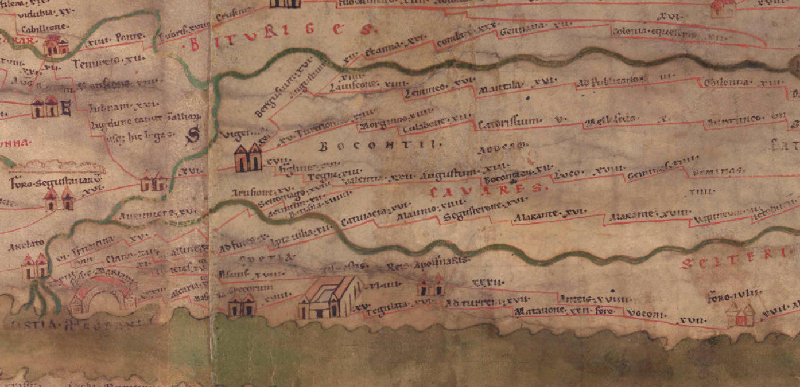 Zum Bildausschnitt auf der gesamten TP |
| Toponym vorher | |
| Toponym nachher | |
| Alternatives Bild | --- |
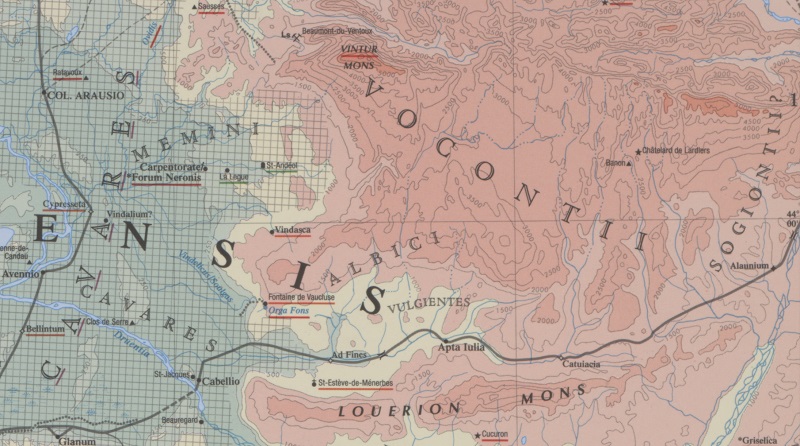
| Bild (Barrington 2000) |
 |
| Bild (Scheyb 1753) | --- |
| Bild (Welser 1598) | --- |
| Bild (MSI 2025) | --- |
| Pleiades: | https://pleiades.stoa.org/places/148241 |
| Großraum: | Gallien/Germanien |
| Toponym Typus: | Ethnikon |
| Planquadrat: | 2B1 |
| Farbe des Toponyms: | schwarz |
| Vignette Typus : | --- |
| Itinerar (ed. Cuntz): |
|
| Alternativer Name (Lexika): | Vocontii (DNP) |
| RE: | Vocontii - https://elexikon.ch/RE/IXA,1_705.png |
| Barrington Atlas: | Vocontii (15 E1) |
| TIR / TIB /sonstiges: |
|
| Miller: | Bocontii |
| Levi: |
|
| Ravennat: |
|
| Ptolemaios (ed. Stückelberger / Grasshoff): | Οὐοκόντιοι (2,10,16; 2,10,19) |
| Plinius: | Vocontii (3,34) |
| Strabo: |
|
| Autor (Hellenismus / Späte Republik): |
|
| Datierung des Toponyms auf der TP: | --- |
| Begründung zur Datierung: |
|
| Kommentar zum Toponym: |
Valentia (lat. „die Kräftige“) war der Hauptort der Segovellauni (Ptol. 2,10,12 s. Kommentar zu Plin. nat. hist. 3,34 Segovellauni), die von manchen antiken Autoren zu den Cavares gerechnet werden (s. Kommentar zu 3,34 Cavres). |
| Literatur: |
Desjardins, Table, p. 6, col. 2-3, no. 15. |
| Letzte Bearbeitung: | 20.08.2026 09:36 |
Cite this page:
https://tp-online.ku.de/trefferanzeige.php?id=2035 [zuletzt aufgerufen am 03.10.2026]